Rose
Laguana

AI operations. I build the systems, I run them, and I stay accountable for the people on the other end of them.

LinkedIn  ·  rose.laguana@gmail.com

Builds

PII Redaction & Ops Automation

Problem
Every week on the road, I submitted expense receipts for reimbursement. They routinely exposed sensitive identifiers (confirmation codes, frequent-flyer numbers, ticket numbers, seat assignments) that have no business living in a finance system. The manual alternative is eyeballing a PDF before you hit send, which is exactly how things get missed.
Business translation
Document risk reduction, finance operations support, repeatable workflow automation, and safer handoffs before sensitive files cross an organizational boundary.
2airline formats
7PII field types
1command, end to end
Python pymupdf regex Gmail API
Approach & what shipped Hide detail
Approach
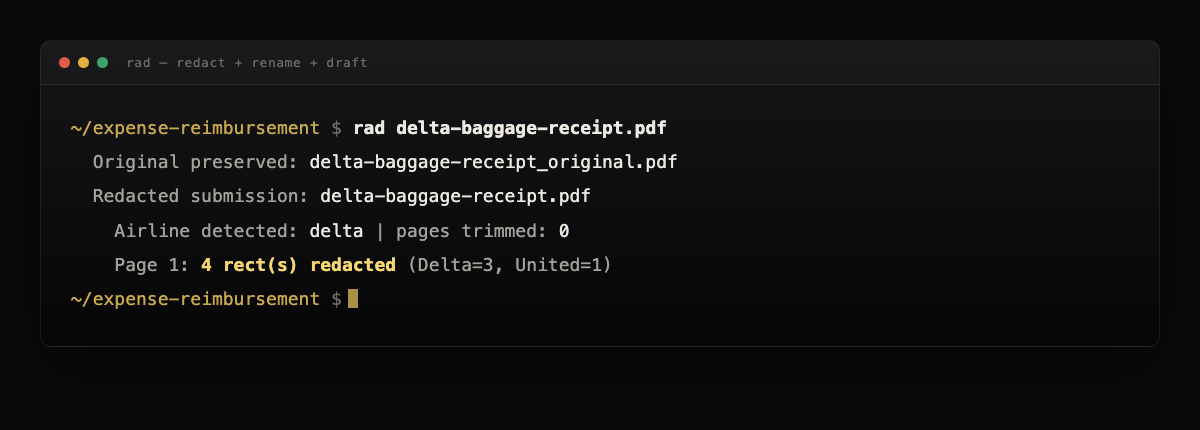
A Python tool (pymupdf) that classifies the document source, trims irrelevant pages, and applies source-specific regex patterns to redact PII, then writes the clean file under a safe-to-submit name and archives the original. Verification is programmatic (re-extract and diff), not visual: a prior visual check missed a redaction bug, so the tool doesn't trust eyes. A single CLI shortcut (rad <pdf>) runs the full pipeline: redact, rename, draft the submission email, then exits.
What shipped
A personal tool used across multiple tour cities on real, time-sensitive documents, starting May 2026. The reusable piece is the pattern: classify document, strip PII by source-specific rules, verify programmatically, automate the downstream action. It applies anywhere receipts, contracts, or HR documents need sanitizing before they cross an org boundary.
Terminal output of the rad command redacting a Delta baggage receipt: airline auto-detected, 4 fields redacted, original preserved under a separate filename.
A real run: airline auto-detected, original preserved, PII redacted, one command.

AI Customer Intelligence Dashboard

Problem
Community feedback (Discord, Reddit, support threads) is unstructured noise. A CX team can read it all day and still struggle to turn it into decisions engineering can act on.
Business translation
Customer success intelligence, account prioritization, stakeholder visibility, and decision support for service, product, or revenue teams.
3triage categories
1-clickengineering digest
Cursor Claude Tailwind CSS JavaScript
Approach & what shipped Hide detail
Approach
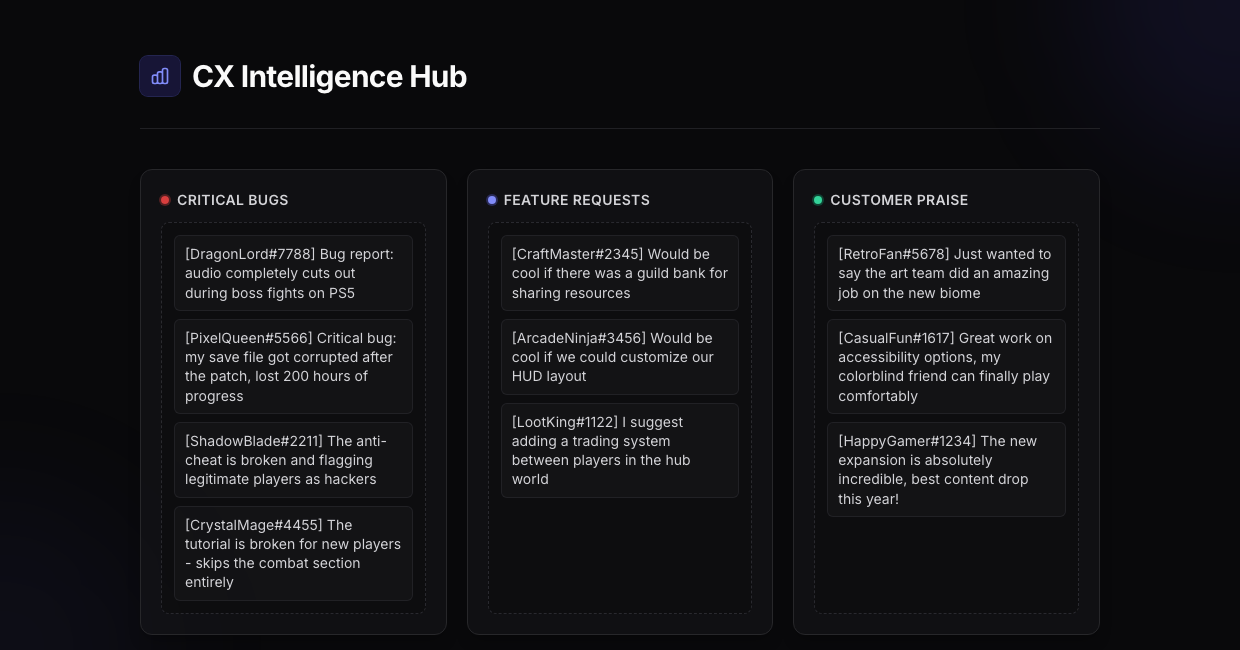
A dashboard that triages incoming messages into Critical Bugs, Feature Requests, and Customer Praise, with a one-click "Copy Summary" that hands engineering a clean digest instead of a raw feed. Built with Cursor and Claude, a Tailwind UI, and modular JavaScript structured to plug into the Claude API.
What shipped
A working proof-of-concept, built as the technical artifact for a Customer Experience Lead application. The reusable piece is the pattern: triage unstructured community feedback into critical bugs, feature requests, and praise, then hand engineering a clean digest instead of a raw feed. It applies anywhere noisy customer signal has to become actionable.
The dashboard after a run: raw community messages sorted into three columns, Critical Bugs, Feature Requests, and Customer Praise.
The live dashboard after one run: raw feedback sorted into bugs, requests, and praise.

Digital Workforce · Agent Hierarchy

Problem
I was running multiple workstreams in parallel, solo (builds, brand, operations, strategy, and research), while touring, on a schedule with no slack. No system held the lanes together, so work kept falling through the seams between them. I'm a builder by reflex: when I hit a bottleneck, I'd rather engineer the fix than route around it. So I didn't buy a tool. I built the operating layer myself.
Business translation
AI workflow orchestration, role-based agent design, operating-system thinking, and scalable delegation for complex parallel workstreams.
29agents
6lanes
3model tiers
Claude Code subagents model tiering governance / autonomy
Approach & what shipped Hide detail
Approach
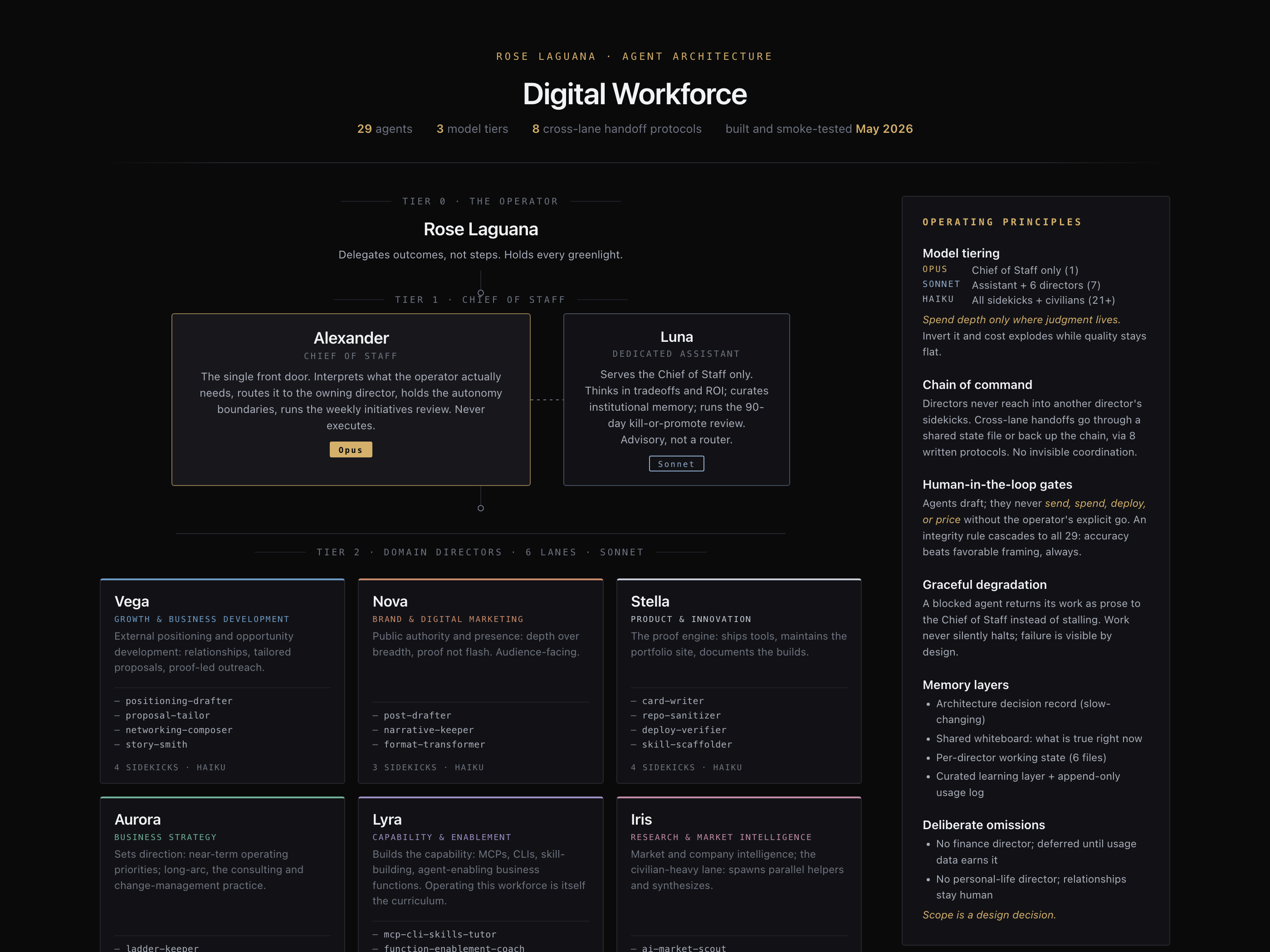
A 29-agent hierarchy in Claude Code: one Opus Chief of Staff as the single interface, a Sonnet dedicated assistant, six Sonnet directors each owning a lane, and 21 Haiku sidekicks for narrow, repeatable tasks. I built the department files through a parallel agent-builder fan-out (the orchestration was the build method) and tiered the models so only the Chief of Staff runs on Opus. Governance, lane discipline, and an append-only usage log were written into the architecture from the start. Smoke-tested end to end, which caught and fixed a real defect before I called it done.
What shipped
29 agents plus their operating docs: routing, autonomy boundaries, a shared state layer, and a memory layer. A request routes Chief of Staff → director → sidekick. This is the build that earns the "orchestrator of agents" line above.
Agent architecture chart: operator at top, Chief of Staff and dedicated assistant, six domain directors each with Haiku sidekicks, and an operating-principles sidebar.
The live org chart, 29 agents across 6 lanes and 3 model tiers.

AI Adoption Readiness · Org Diagnostic

Problem
Every AI pilot conversation starts with the technology and skips the harder question: is the organization ready? No accountable owner, no scoped use case, no data foundation, anxious teams. The failure points repeat from org to org, but leaders rarely have a structured way to see them before the pilot stalls.
Business translation
AI adoption assessment, change-readiness diagnosis, enablement gap analysis, and executive decision support for teams bringing agents into real workflows.
6dimensions
5maturity levels
3demo companies
JavaScript Vercel deterministic rubric no backend
Approach & what shipped Hide detail
Approach
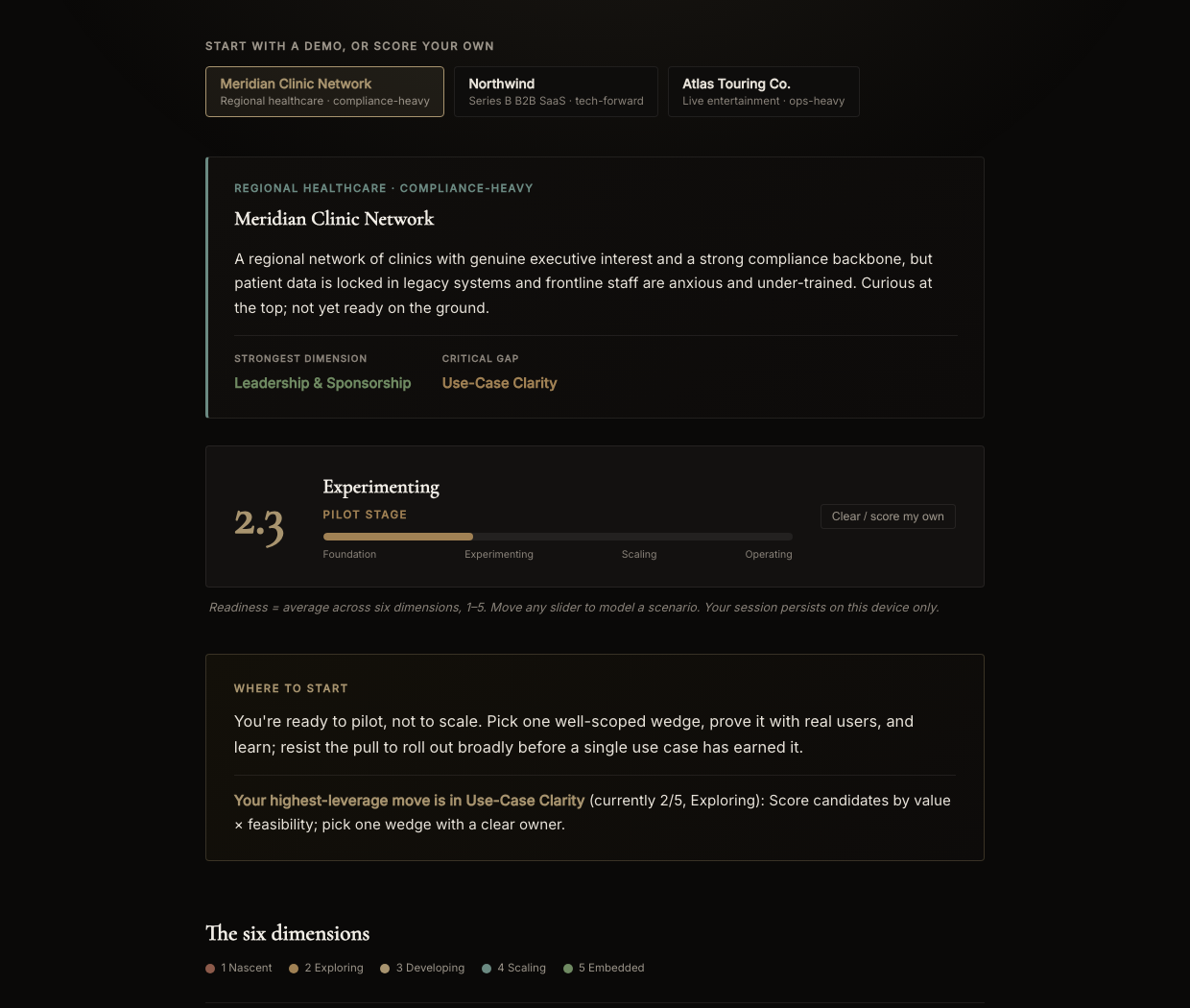
I designed a six-dimension readiness rubric (leadership and sponsorship, use-case clarity, data and tooling, workforce capability, governance, and change capacity) with five maturity levels each, then built it as a self-contained diagnostic. Load a fictional demo company or set the sliders yourself; the tool returns a readiness score and band, a per-dimension reading, and the single highest-leverage next move. Deterministic rubric, no backend, nothing tracked.
What shipped
A live public instrument with three clearly fictional demo companies: a cautious clinic network, a SaaS team outrunning its own governance, and a touring production company whose people are ready before its systems are. The sixth dimension, change capacity, is the deliberate differentiator: adoption is a people problem before it is a technical one.
The diagnostic with a demo company loaded: readiness score 2.3 in the Experimenting band, the maturity ramp from Foundation to Operating, strongest dimension and critical gap named, and the single highest-leverage next move called out.
The live diagnostic with a demo company loaded: score, band, strongest dimension, critical gap, and the one move that matters most.

Where this work fits

The builds above are my own. Some came out of work in front of me, the rest I built to develop the skill directly. What they share is a single function, and the market is still naming it: AI operations, agent operations, forward-deployed enablement, internal FDE. Underneath the titles it's one job, and I've been moving toward it on a deliberate line: building the practice before the category settled on a name for it. This is that work, in the terms an org actually uses:

AI Operations & Agent Operations
Designing a governed fleet of agents rather than demoing one. The 29-agent workforce has defined lanes, governance, and autonomy boundaries; the build pipeline has an audit trail and a human as its final gate; a scheduled agent runs whether or not I'm awake. This is the through-line under everything else on this page.
Customer Success & CS Operations
The dashboard pattern: noisy customer signal becomes triaged, actionable decisions. Underneath it, retention instinct from a decade of clients who rebooked every year.
Operations & Implementation
The redaction pipeline pattern: classify the document, sanitize it by rule, verify programmatically, automate the handoff. Ops discipline that doesn't trust eyes when a script can check.
AI Adoption, Enablement & L&D
The 29-agent workforce shows what structured AI work looks like: clear lanes, governance, and autonomy boundaries a team can actually operate. Alongside it, a draft methodology for how teams adopt new technology.
People Operations & Workforce Enablement
The readiness diagnostic pattern: score whether an organization's people are actually prepared for a change before you roll it at them. This sits underneath the operations work rather than beside it: adoption is where a rollout succeeds or quietly fails.

Operating experience, translated

A decade of annual rebooking at Dot Dot Dot Account management and retention: clients who choose you again every year
1,900+ Cirque shows, then a Broadway National Tour Execution under hard deadlines, reliability you can plan around
A new city and venue every week, same standard Process design: rebuilding a workflow in new conditions and improving it each pass
Production, management, musicians, crew, venues Cross-functional stakeholder coordination in fast-moving environments
Standing between the business side and the creative side Translating between functions that define success differently, and getting them to move together
Re-hired contract after contract, tour after tour The thing that keeps you in the room: low drama, high reliability, easy to work with under pressure

About

I started as a professional musician in 2000 and spent 2005 through 2026 on the road, which is longer than the ten-year warranty on my luggage. 1,900+ shows with Cirque du Soleil, with an annual contract renewal year after year, and I missed only a handful across five and a half years of ten-show weeks. Then a Broadway National Tour, returning consecutively for the last four years. And Dot Dot Dot LLC, the venture I co-founded and operated around my own produced albums, where clients rebooked every year for a decade. I'm still playing. I'm also building what comes next, in the open, before I need it.

The reliability is the part I'd point at first. Five and a half years of that, at ten shows a week, and I can count the ones I missed. In a live operation there is no rescheduling and no second take, so being the person who is reliably there is not a soft quality, it's the whole job. It also taught me what it costs to be that person, which is a large part of why I care how the next place treats the ones who are.

Breaking into that industry is one thing. Staying in it is a different game. Continuity of work comes from the job you do and from everything around the job: working well with people, leaving your ego at the door and offstage, and knowing you're there to connect with an audience rather than to be the point. It takes understanding how the business side and the creative side actually fit together and being able to move between them, in rooms where the stakes are high and nobody has time for you to be difficult. That is a discipline, and it took years. It's also the half of AI operations that job descriptions underweight. The tools are learnable. Getting a room of people to genuinely change how they work is the part that isn't.

That's the part I don't have a tidy story for yet. I'm in the middle of a change I chose, without a finished map, building the proof in public as I go. Some of what's on this page has done real work. Some of it is a draft I'm still arguing with. I've said which is which, because a portfolio that hides its seams isn't proof of anything.

What I keep building, without setting out to, is the same thing. A diagnostic that scores whether an organization is actually ready to adopt AI. An agent workforce with governance and autonomy boundaries, so a person always knows what the machine is allowed to decide on its own. A multi-agent build pipeline whose final gate is a human being. I didn't plan a theme. I have one.

So here it is plainly. My read is that AI adoption fails on people far more often than it fails on technology, and that most organizations are far better resourced to fix the technology. I want to work where someone is accountable for the humans in that equation. That's the direction. Everything on this page is me earning my way toward it. Proof, not flash.